 NoaLingua
 Article
Why you forget vocabulary, and what NoaLingua does about it
Why you forget vocabulary you were sure you had learned
You forget because recognising a word and being able to retrieve it are different abilities, and only retrieval is durable. Memory for a new word decays sharply within days unless it is recalled from scratch at least once. Re-reading a list feels like studying and produces almost no retention, because nothing was retrieved.
Forgetting is the default, not the failure
The experience is universal: you look a word up, you understand the sentence, you feel you have learned it, and four days later it is gone. People treat this as evidence of a bad memory. It is evidence of a normal one.
Ebbinghaus measured the shape of this in the 1880s and it has held up: retention of something learned once falls steeply in the first day or two, then flattens into a long slow decline. The curve is not a personal failing to be overcome by trying harder. It is the baseline behaviour of memory, and the only thing that changes it is meeting the item again.
Recognition is not retrieval, and only one of them counts
Here is the trap. When you read a word with its translation underneath, you recognise it. Recognition is easy, feels like knowing, and is a poor predictor of whether you could produce the word tomorrow.
Retrieval — being shown the word and pulling the meaning out of your own head, or being shown the meaning and producing the word — is harder, feels worse, and is what actually strengthens the memory. The difficulty is not incidental to the benefit; it is the benefit. Psychologists call this desirable difficulty, and it is why highlighting a textbook does so little.
This is the single reason passive watching with dual subtitles teaches less than it feels like it should. Every line is recognised and none is retrieved. The subtitles are not the problem — they are what makes the material comprehensible at all — but they have to be paired with something that makes you produce.
The spacing effect, in one paragraph
Reviewing the same word five times in one sitting is worth far less than reviewing it five times across three weeks, even though the total effort is identical. Spreading the reviews out forces a partial forgetting between them, and recovering from partial forgetting is what makes the memory durable.
The optimal moment to review is just before you would have forgotten — late enough that recall is effortful, early enough that it succeeds. Nobody can judge that by feel, which is the entire reason scheduling software exists. A system that widens the interval on a correct answer and shortens it on a wrong one is approximating that moment for every card independently.
Why the sentence matters as much as the word
A word saved as a bare pair — arbitrage / refereeing — is a translation exercise. A word saved with the sentence it appeared in, the source it came from and the moment it was said is a memory with handles on it.
This matters more than it sounds. Most words do not have one meaning; they have a meaning in a context. Saving the context means that when the card comes back in nine days you are recalling something that actually happened to you, and that recall is far more likely to succeed.
It is worth doing this by hand if your tool does not do it for you — paste the sentence into the card. NoaLingua keeps the sentence, its translation, the source and the timestamp automatically because the alternative is a deck of orphaned pairs, but the principle holds whatever you use.
What to actually do
Three changes, in order of how much they return for the effort.
- Stop re-reading. If you are not producing an answer from memory, you are not studying, however long you spend.
- Capture the sentence, not the word. Any word worth saving appeared somewhere; save where.
- Let something else decide when to review. The interval that feels right is almost always too short — see <a href="/features/vocabulary-review/">how the schedule works</a> for one implementation of this.
First-hand product evidence
The related workflow, shown in NoaLingua
Source and version reviewed · version 0.2.36
What is visible: The capture shows saved words with their source sentences, status labels and attempt counts in the local material view.
What this does not prove: It does not show cloud sync or shared decks; NoaLingua deliberately stores this material on the user's device.
-
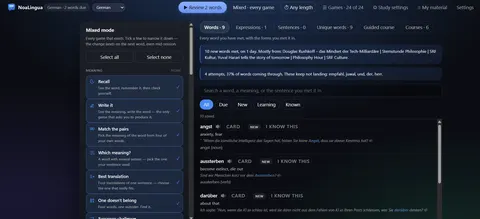
Everything you saved. Every word with the sentence you met it in, its status, and how it is going — searchable by any of the three.
See the full Vocabulary review mechanism, fit and limits. The only altered pixels in these plain captures are the product name in the corner; the repository screenshot script documents each patch.
Evidence
Sources behind this NoaLingua article
These sources support the research and platform claims used above. Product links are first-hand NoaLingua captures or documentation; external links lead to the original paper or the product's own help page.
- Research Test-enhanced learning: taking memory tests improves long-term retention Henry Roediger & Jeffrey Karpicke, Psychological Science, 2006 The distinction between rereading and effortful retrieval, and the long-term retention benefit of retrieval practice.
- Research Distributed practice in verbal recall tasks: a review and quantitative synthesis Nicholas Cepeda et al., Psychological Bulletin, 2006 The spacing effect and the relationship between study interval and the time knowledge needs to be retained.
- First-hand product evidence Vocabulary review: product evidence and scheduling limits NoaLingua feature documentation A plain capture of saved contextual material and the documented local review workflow.
Read next
Try NoaLingua on the next video you were going to watch anyway.
Free, with every feature. No account, nothing to cancel, and your deck stays on your machine.
Add to Chrome — Free Add to Chrome Opens the Chrome Web Store listing NoaLingua — beyond dual subs: video, web, PDF — free, no account, Chrome 138 or newer.- Free, and not a trial Every feature on the free plan — both PDF modes, shadowing, all 30 practice formats.
- No account, no email Nothing to sign up for and nothing to cancel. There is no login screen at all.
- Two dropdowns to set up Pick what you are learning and what you want translations in. That is the whole setup.
- Your words stay yours Export to Anki, CSV, a spreadsheet or a full JSON profile — free on every plan.