 NoaLingua
 Article
Learning vocabulary from what you already read, with NoaLingua
How to get vocabulary out of articles and books you are already reading
Reading exposes you to far more vocabulary than listening does, but almost none of it is retained because looking a word up mid-paragraph is immediately forgotten. The fix is to separate reading from studying: read for meaning without stopping, mark rather than look up, and process the marks afterwards in one pass.
Reading is the underused half
A page of ordinary prose holds several hundred words. An hour of reading exposes you to more vocabulary, and more varied vocabulary, than an hour of television, because written language is denser and less repetitive than speech.
It is also where the least is captured. Almost everyone has the same experience: look a word up, understand the sentence, keep reading, and have no memory of the word by the end of the chapter. The exposure happened. The learning did not.
Why looking things up mid-paragraph fails
Two reasons, and they compound. The first is that the lookup is a recognition event, not a retrieval one — the same failure described in why you forget vocabulary. You saw the answer; you did not produce it.
The second is that stopping destroys the read. Every interruption costs you the thread, so you either stop looking things up (and understand less) or stop reading properly (and enjoy it less). Most people oscillate between the two and conclude that reading in a foreign language is unpleasant.
Separate the reading from the studying
The workflow that solves this is old and works on paper as well as on screen: do the two jobs at different times.
- Read for meaning. Do not stop. Where a word blocks you, mark it and move on — a pencil line, a highlight, a click, whatever costs you the least attention.
- Guess as you go. Guessing from context is itself a retrieval act, and being wrong is fine; you will find out shortly.
- When the chapter or article is finished, go back through your marks in one pass. This is now studying, and it is not competing with reading.
- Keep only the words that are worth keeping: ones in the top few thousand by frequency, or ones you have now met twice. A rare word met once is not worth a card.
- Save each with its sentence. The sentence is what makes it retrievable later.
Doing this on a screen
On paper the marking is a pencil. On a screen it can be cheaper still, which matters because the cost of the interruption is the whole problem.
NoaLingua exists partly for this: click a word on any web page or inside a PDF and the card opens with the meaning that word has in that sentence, with saving as one more click and no navigation away from what you were reading. The sentence, the page and the source come with it automatically.
It is not the only way and it is not necessary. A notes file with pasted sentences and a free flashcard program does the same job for nothing. What matters is that the capture is cheap enough that you actually do it, and that the sentence comes along.
What to read
Apply the same test as anywhere else: around 4 to 10 unavoidable lookups per 200 words, per the level test. Below that you are having a nice time; above it you are decoding.
Journalism is the most reliable starting point in most languages — short pieces, plain register, current vocabulary, and a natural stopping point every few hundred words. Novels are the harder and better long-term option, because the vocabulary repeats within a single book and repetition inside a context you care about is the most efficient learning there is.
First-hand product evidence
The related workflow, shown in NoaLingua
Source and version reviewed · version 0.2.36
What is visible: The capture shows saved words with their source sentences, status labels and attempt counts in the local material view.
What this does not prove: It does not show cloud sync or shared decks; NoaLingua deliberately stores this material on the user's device.
-
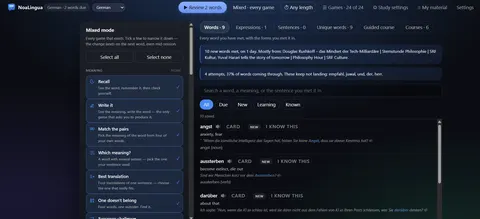
Everything you saved. Every word with the sentence you met it in, its status, and how it is going — searchable by any of the three.
See the full Vocabulary review mechanism, fit and limits. The only altered pixels in these plain captures are the product name in the corner; the repository screenshot script documents each patch.
Evidence
Sources behind this NoaLingua article
These sources support the research and platform claims used above. Product links are first-hand NoaLingua captures or documentation; external links lead to the original paper or the product's own help page.
- Research The effects of repetition on vocabulary knowledge Stuart Webb, Applied Linguistics, 2007 Controlled evidence that repeated encounters can build different aspects of word knowledge over time.
- Research How effective is second language incidental vocabulary learning? A meta-analysis Stuart Webb et al., Language Teaching, 2023 Evidence and moderators for learning vocabulary incidentally through reading, listening, viewing and combined input.
- Research Unknown vocabulary density and reading comprehension Hu Hsueh-chao & Paul Nation, Reading in a Foreign Language, 2000 The empirical basis for discussing lexical coverage. Its thresholds come from one reading experiment and are guidance, not a universal pass mark.
- First-hand product evidence Vocabulary review: product evidence and scheduling limits NoaLingua feature documentation A plain capture of saved contextual material and the documented local review workflow.
Read next
Try NoaLingua on the next video you were going to watch anyway.
Free, with every feature. No account, nothing to cancel, and your deck stays on your machine.
Add to Chrome — Free Add to Chrome Opens the Chrome Web Store listing NoaLingua — beyond dual subs: video, web, PDF — free, no account, Chrome 138 or newer.- Free, and not a trial Every feature on the free plan — both PDF modes, shadowing, all 30 practice formats.
- No account, no email Nothing to sign up for and nothing to cancel. There is no login screen at all.
- Two dropdowns to set up Pick what you are learning and what you want translations in. That is the whole setup.
- Your words stay yours Export to Anki, CSV, a spreadsheet or a full JSON profile — free on every plan.